Humanity hides underground. You found an Airlock.

What is AIRLOCK?

A post-apocalyptic open-world survival base-builder. The Last of Us meets The Alters.

Open-world surface exploration, dollhouse underground base-building, survivor settlement management, and a story about an ancient soul trying to undo the end of the world.

SURVIVE

The surface is hostile. The Altered own it. Scavenge for food, weapons, medicine, and blueprints. Fight or flee. Make it home alive. Permadeath means every trip is a gamble.

PROTECT

Rescue survivors and give them a home. Manage food, water, morale, and grief. Every person has a name, a story, and skills that matter. Lose them and they're gone forever.

DISCOVER

Uncover a three-layer mystery about who you are, what happened to the world, and why the enemies hesitate around you. Memory fragments triggered by exploration change everything.

The Story

You wake up. Alarms blaring. A dim room — medical equipment, dead monitors, restraints on the bed. You don't know who you are. You stumble through corridors lined with bodies, out into a world consumed by 300 years of ruin.

A dead man in a jeep. A satnav with a destination. You drive. That destination is an Airlock — an underground shelter. This is where your life begins. But as you build, rescue, and survive... fragments of memory surface. And the truth about who you are will change everything.

Three layers of revelation. Each one reframes everything you thought you knew.

— The Airlock

The World

THE SURFACE

300 years after the Sonic Nuclear War. Cities overgrown. Sky toxic. The Altered own every inch. Day is tense. Night is deadly.

THE UNDERGROUND

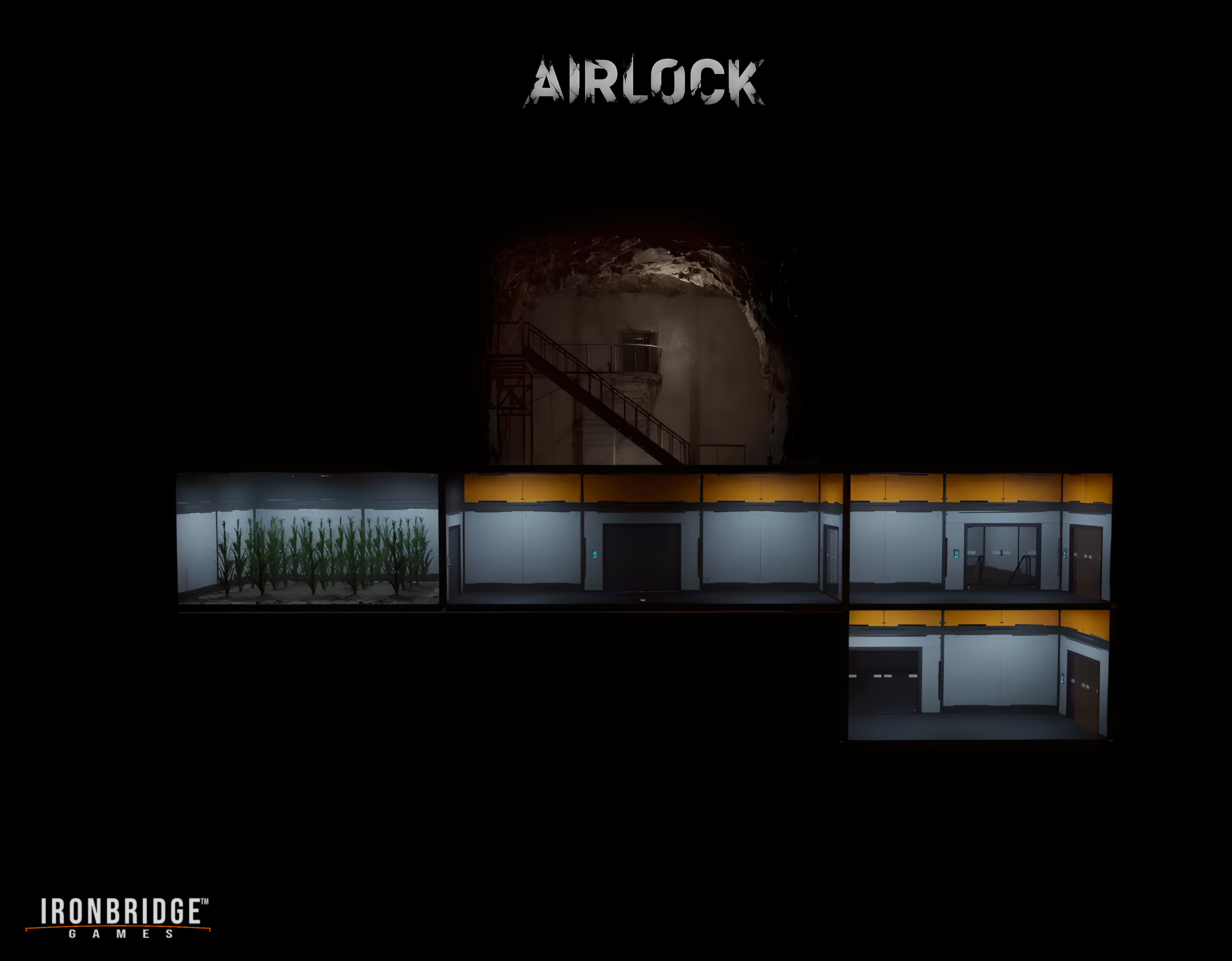
Your sanctuary. Expand left, right, and downward. Manage power, water, and ventilation — three systems where one failure cascades into disaster.

THE ALTERED

THE DUMB

Pure aggression. No tactics. Dangerous in swarms.

THE STALKERS

They follow from shadows. They watch. They attack at the worst possible moment — or not at all.

THE LEGION

The apex threat. A hive intelligence — hundreds of minds acting as one. They have a complicated relationship with you specifically.

Key Features

Base Building

Build in dollhouse view, then explore your creation in full 3D. 14+ module categories. Five tiers from cave dirt to sci-fi metal.

👥

Survivor Management

Every survivor has a name, background, and skills that unlock new modules. Permadeath means every loss is permanent.

Infrastructure

Power, Water, Ventilation — three interconnected lifelines. A blackout cascades into disaster.

🗺

Open World

Ruined cities and countryside. Dynamic day/night cycle. The surface rewards the brave and punishes the reckless.

🚗

Vehicles

Scout bikes, salvage trucks, armoured carriers. Fuel is finite. Noise attracts enemies.

🐔

Animal Farming

Chickens, cattle, sheep, pigs, bees, and bioluminescent cave creatures underground.

💭

Memory System

Fragments of your past triggered by places, objects, and people. Early ones confuse. Late ones devastate.

👶

Generational

Survivors form relationships. Have children. A generation born underground who have never seen the sky.

Development Roadmap

Click any phase to see details
Building the Demo
Prototype
Grid System
Character
UI & HUD
Combat
Building v2
Hordes
Loot
9
Character V2
10
Companion
11
City & Story
Demo
Phase 1 — Blockout & Prototype
✓ Complete
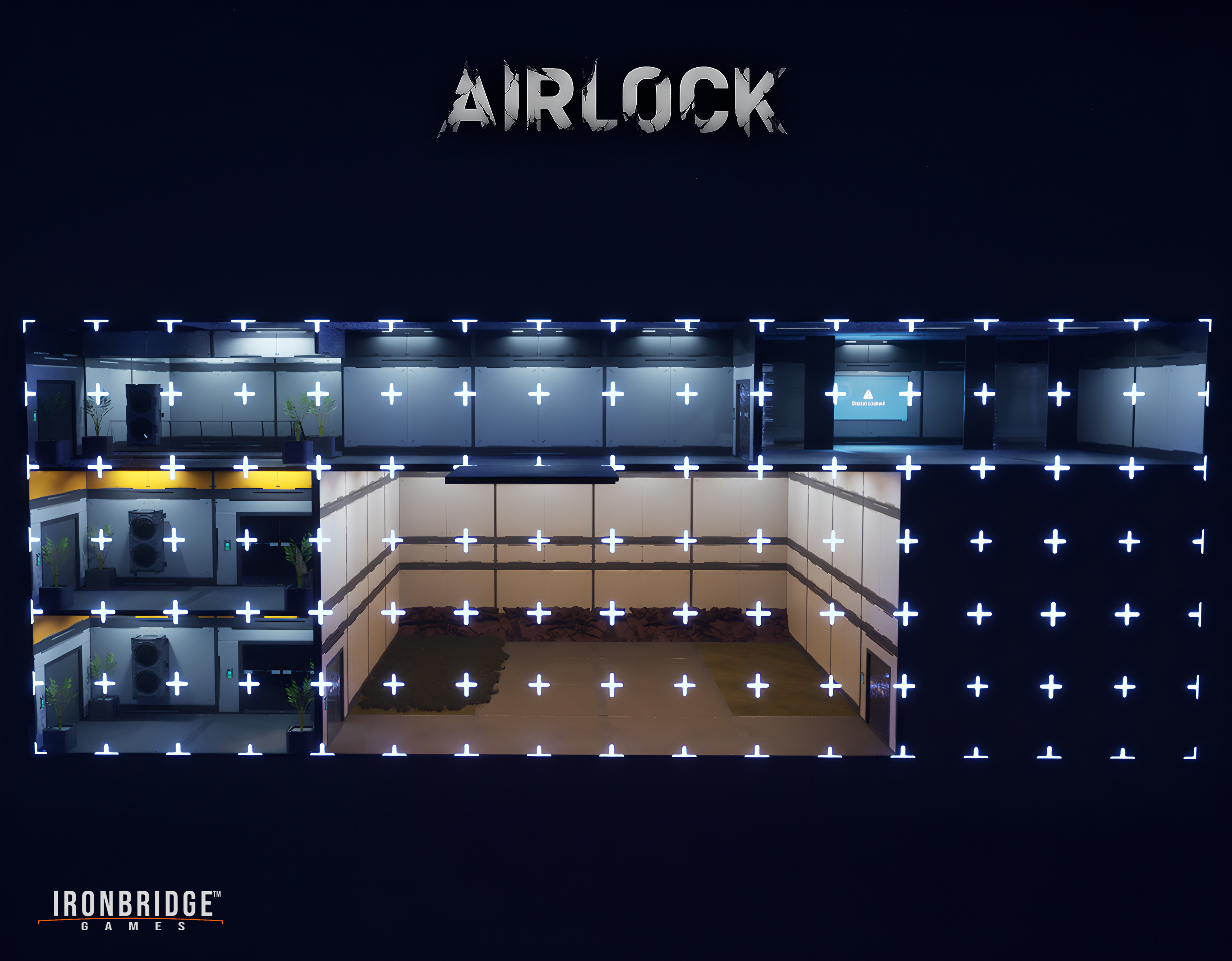
This is where it all started. Built a military compound blockout in Unreal Engine 5 to prove the concept actually works. Integrated the ALS (Advanced Locomotion System) for third-person character control. Created a prototype dollhouse camera to test the core vision — build underground in top-down, then drop into your creation in full 3D and explore it. Walk through the corridors you built. See the rooms you placed. The question was simple: does it feel right? It did. That was the moment AIRLOCK stopped being an idea and started being a game.
AIRLOCK Prototype — dollhouse view of underground base
Phase 2 — Grid & Module System
✓ Complete
The backbone of the entire game. Built the GridManager system in C++ from scratch — world-to-grid coordinate conversion, cell states (empty, occupied, reserved), multi-floor support for stacking levels underground. Created a library of blueprint modules that snap to the grid: corridors, stairwells, bedrooms, kitchens, farms, generators, med bays and more. Each module locks into place with adjacency detection, and walls and doors auto-generate between rooms. This is the system everything else is built on top of.
AIRLOCK Grid System — module grid with placement markers
Phase 3 — Movement & Character
✓ Complete
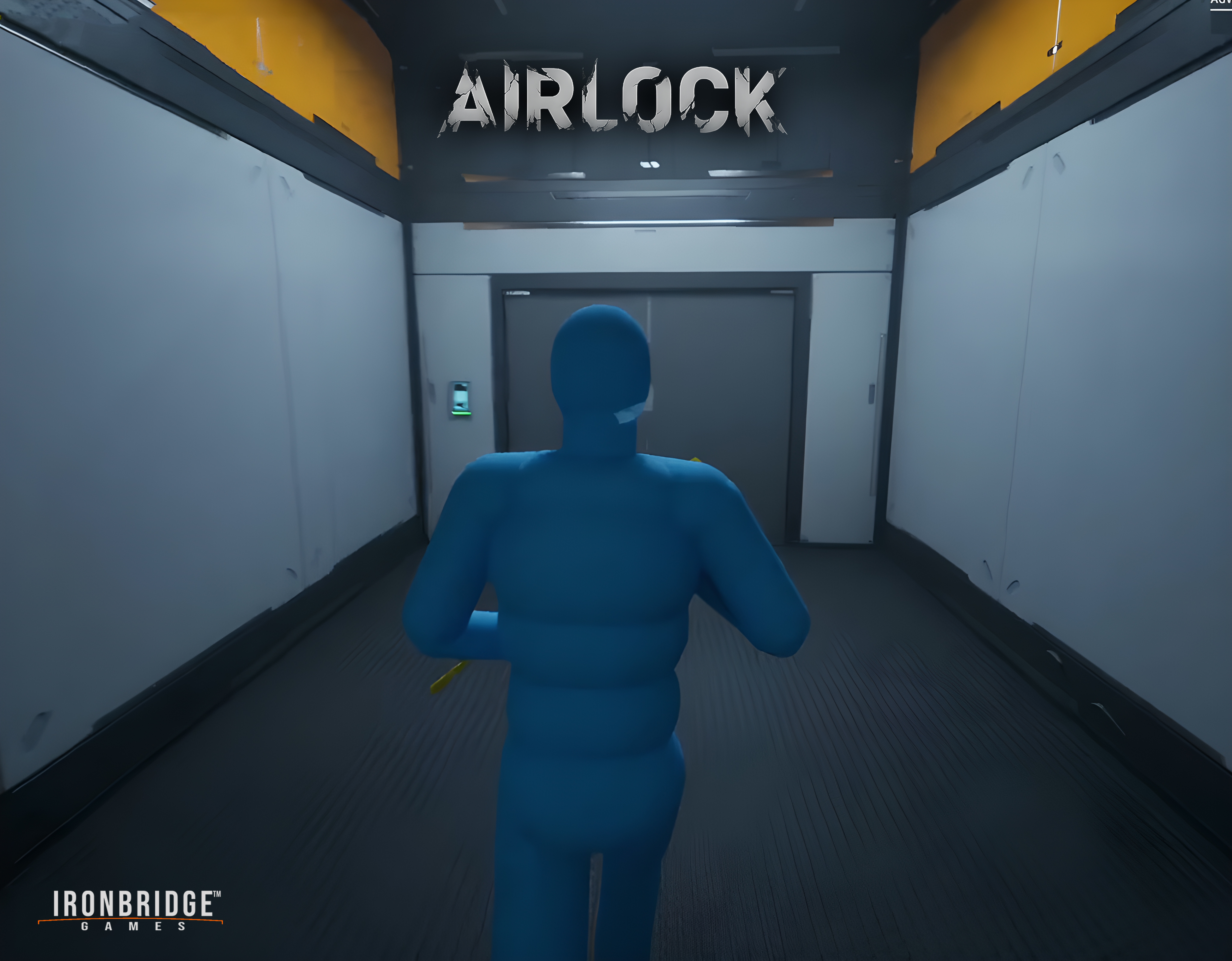
Took the ALS system apart and rebuilt it for AIRLOCK. Customised the movement feel, camera behaviour, interaction ranges, and transitions between exploration modes. The character controller handles both tight underground corridors (managing your base, checking on survivors) and wide-open surface exploration (scavenging, fighting, running for your life). Two very different feels, one seamless character.
AIRLOCK Character — third-person movement in underground corridor
Phase 4 — UI, HUD & Inventory
✓ Complete
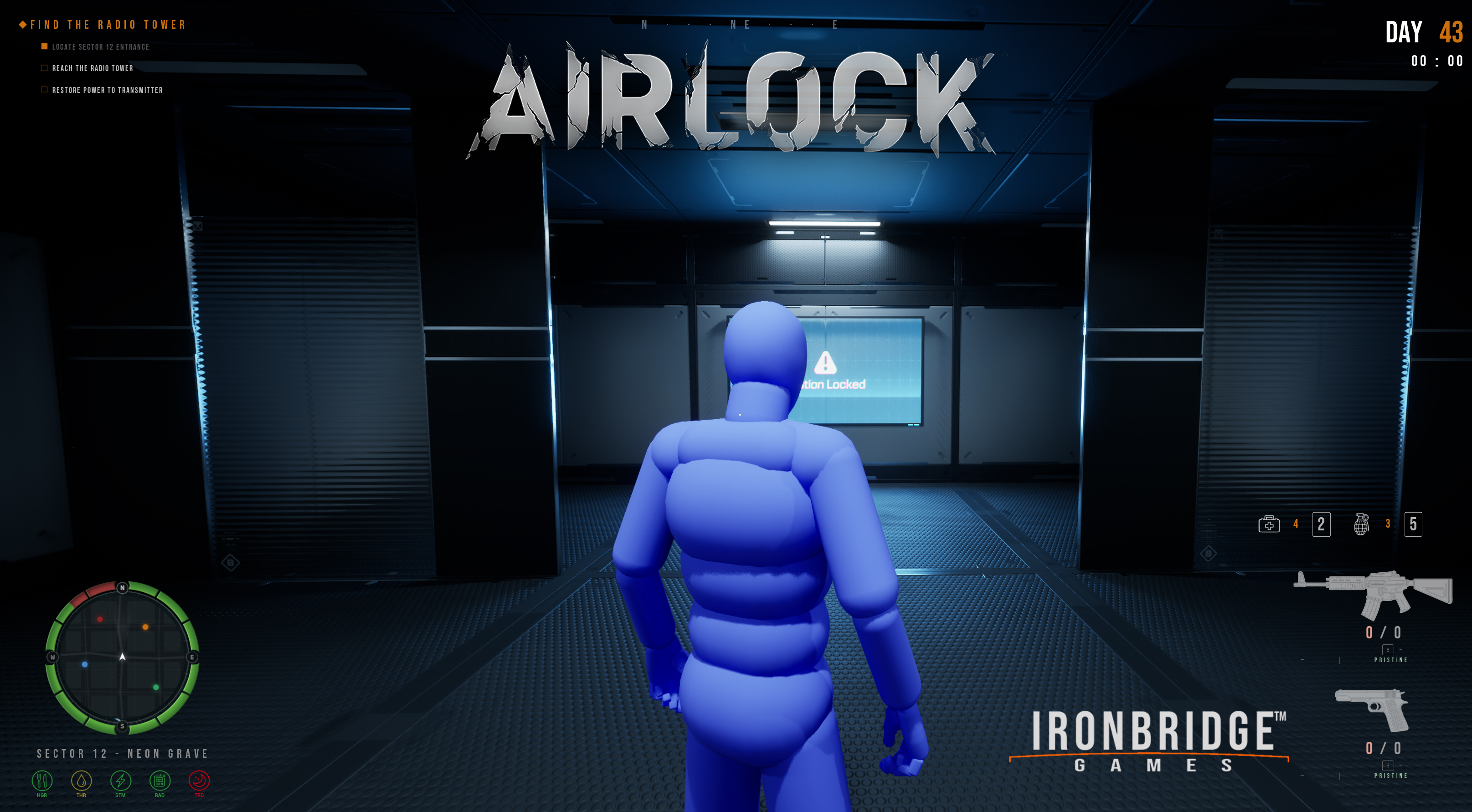
Built the full main menu system from scratch — epilepsy warning screen, brightness calibration, press-any-key splash screen, main menu with all sub-screens and settings. Then built the in-game HUD: health, stamina, compass, status effects, notifications. Created a full inventory system — equip weapons, fire them, swap them, drop items, pick things up. Items degrade over time — nothing lasts forever in AIRLOCK. The entire UI is custom-designed with a teal/steel military aesthetic that feels like it belongs in a bunker.
AIRLOCK UI & HUD — full in-game interface
Phase 5 — Weapons & Combat
✓ Complete
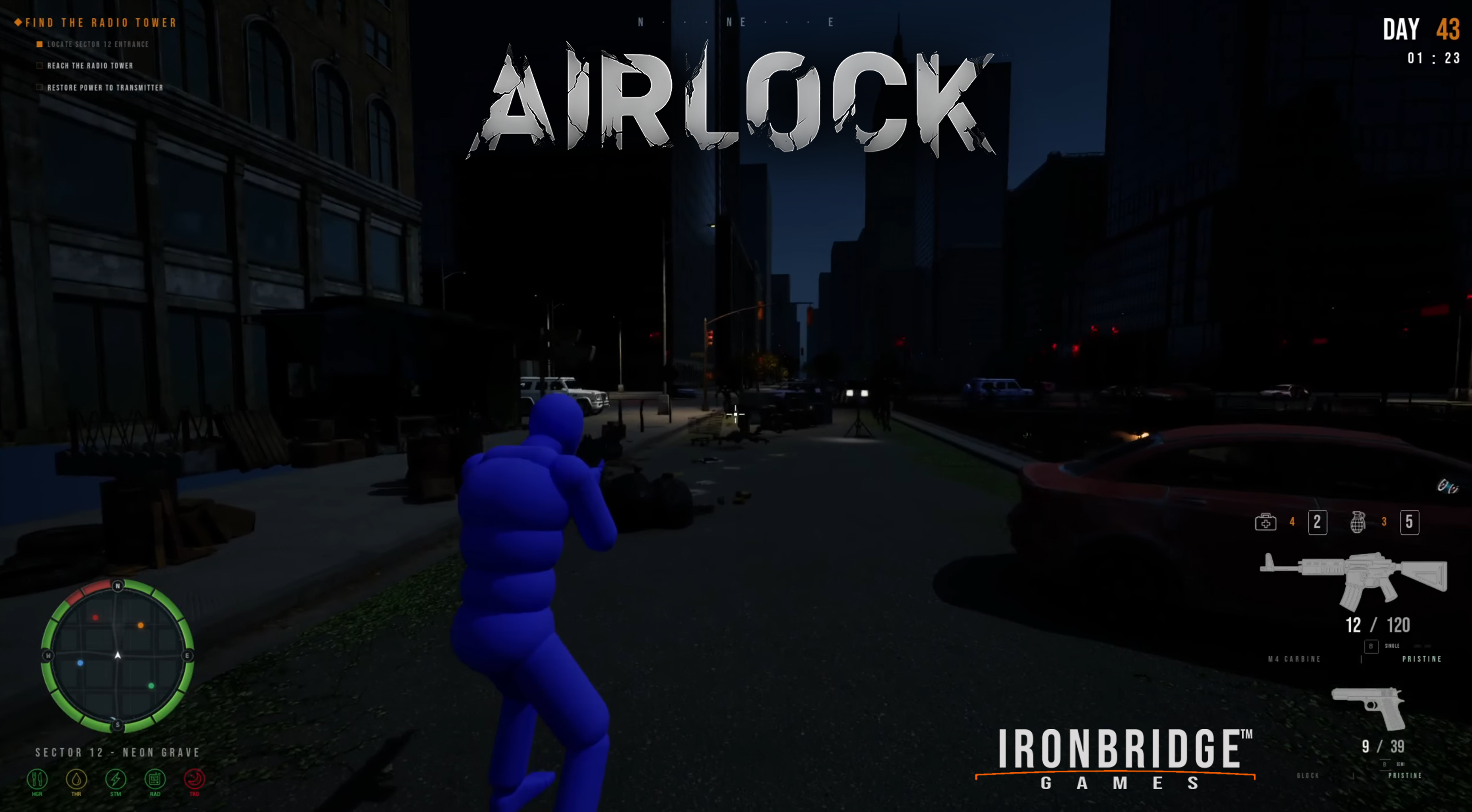
Weapons you can equip, fire, and feel. Ranged and melee combat integrated with the inventory system — every weapon takes a slot, degrades with use, and can break. Ammunition is scarce, so every bullet matters. Combat is designed to feel desperate, not heroic. You're not a soldier — you're a survivor. When a horde finds you, the smart play is to run. When you can't run, you fight. And when your weapon jams at 12% condition, you learn to take better care of your gear.
AIRLOCK Combat — night city streets, weapon drawn
Phase 6 — Module Building v2
✓ Complete
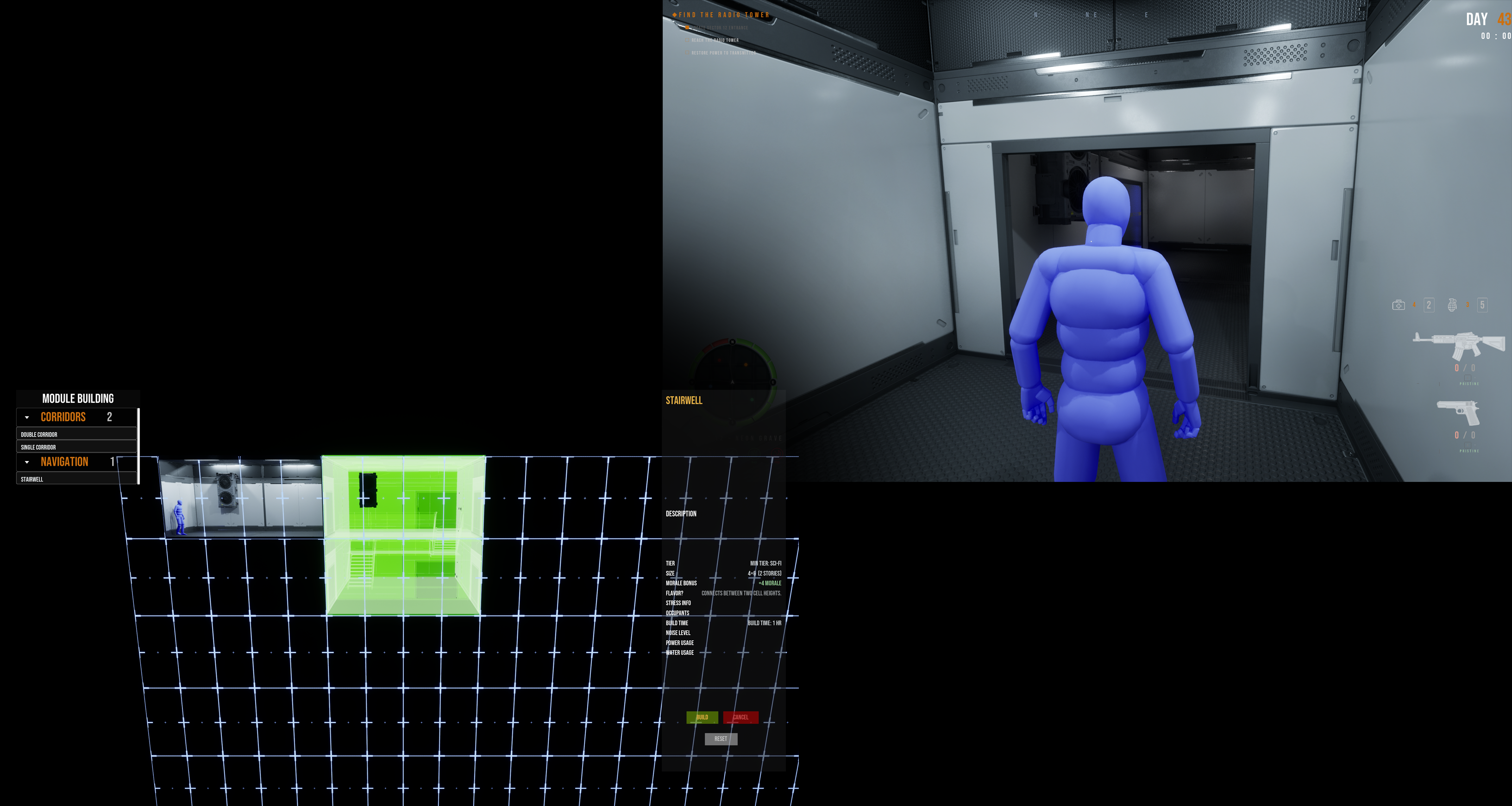
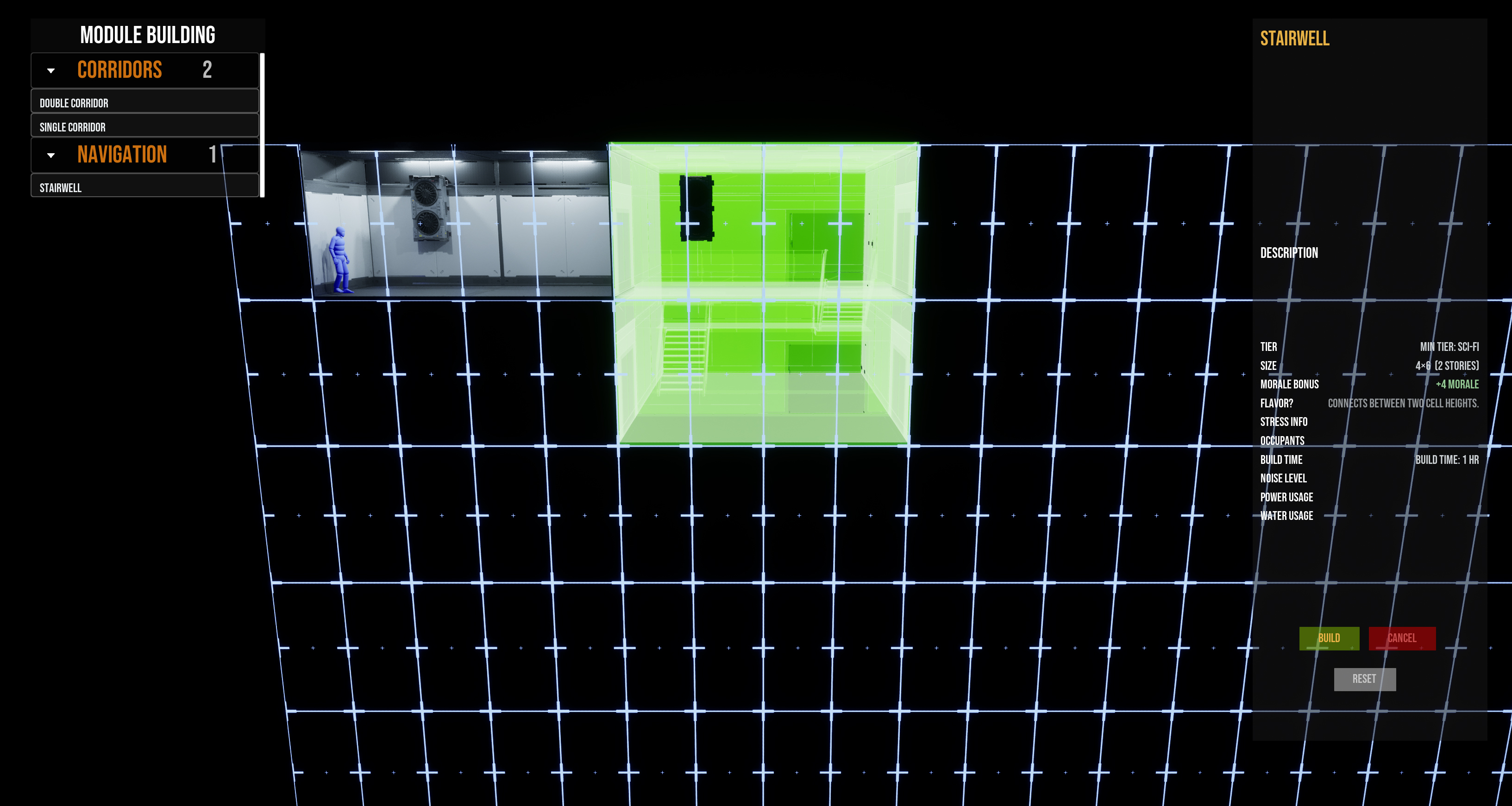
The first version worked. The second version sings. The module system is fully integrated into the HUD — browse 14+ categories, see every detail before you place (tier, size, morale bonus, build time, power draw, water usage). Place, move, remove. Watch your survivors use what you build — the cook prepares meals, crops grow in your farm, generators hum keeping lights on, people socialise in the common room. It's not just building — it's bringing your base to life.
AIRLOCK Building V2 — module placement with stats panel
Phase 7 — Horde System
✓ Complete
Inspired by Days Gone, built for AIRLOCK. An optimised horde system — large numbers of enemies on screen without tanking performance. AI states: idle wanderers, alerted searchers, full-speed chasers, swarming attackers. They don't stand around waiting to be shot. They hunt. They swarm. They overwhelm. Daytime is tense — you're always scanning. Night is deadly. The hordes own the dark.
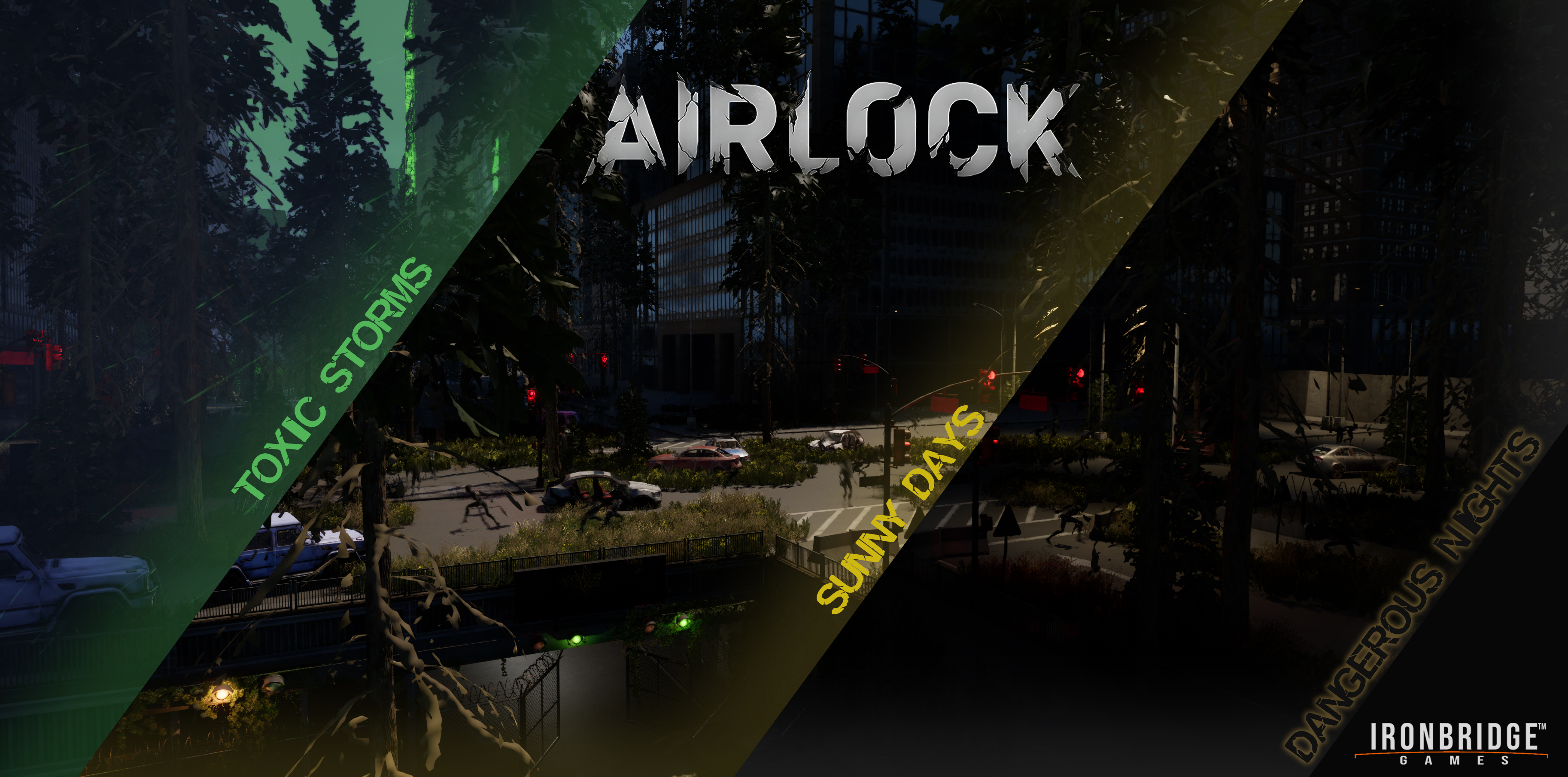
AIRLOCK Weather — toxic storms, sunny days, dangerous nights
Phase 8 — Loot System
⧗ In Progress
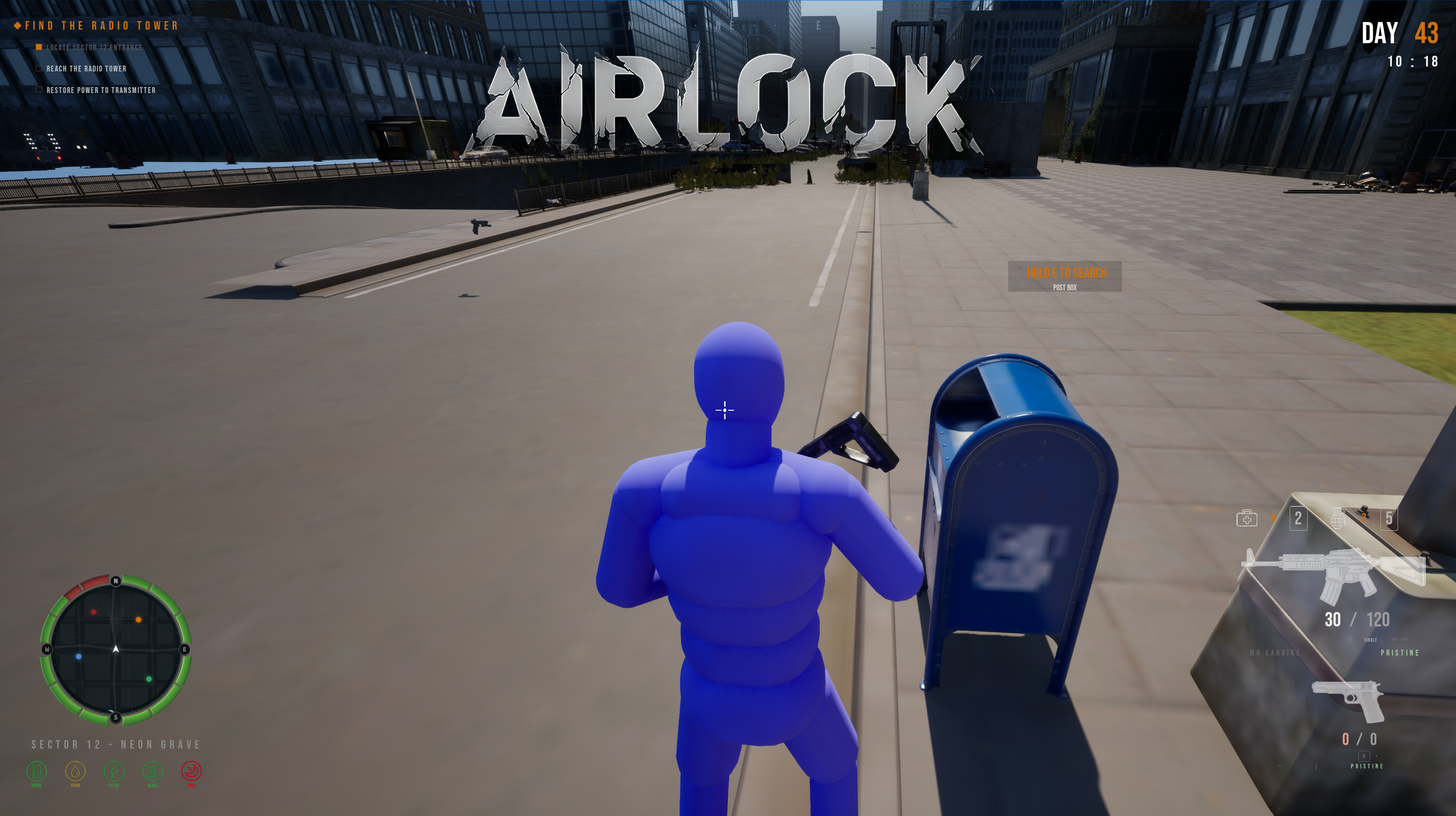
The world needs to feel lived-in and worth exploring. Lootable items scattered throughout ruined buildings, abandoned vehicles, and the remains of those who didn't make it. Food, weapons, medicine, blueprints, raw materials, rare components. Every surface trip is a risk-reward calculation — push deeper for better loot, or play it safe near the airlock? Currently implementing final loot tables, container interactions, and the visual feedback that makes finding good loot feel rewarding.
AIRLOCK Loot — searching containers on the surface
Phase 9 — Character V2 (MetaHuman)
→ Next
Out with the placeholder, in with the real thing. Replacing the ALS mannequin with a fully assembled MetaHuman character — realistic face, hair, skin, expressions. This isn't just a visual upgrade, it's the foundation for cutscenes, emotional storytelling, and characters you actually care about. The MetaHuman needs to work seamlessly with every existing system: movement, combat, inventory, building mode. One swap, zero breakage. That's the goal.
Phase 10 — Companion System
→ Planned
You shouldn't face the surface alone. Your companion follows you — engaging enemies, sniffing out hidden loot, reacting to danger before you see it. They have personality. They have moods. They remember. A presence that makes the crushing loneliness bearable — and makes losing them devastating. This isn't a combat pet. This is the one thing that keeps you sane out there.
Phase 11 — City & Narrative
→ Planned
Turn the sandbox into a world with purpose. A fully explorable ruined city — 4 to 8 square kilometres of destroyed streets, overgrown buildings, collapsed infrastructure. Key points of interest drive the story forward. The narrative framework: three-layer reveal, memory triggers, environmental storytelling, the opening sequence. The city is where the lore lives — in graffiti on walls, in notes left behind, in the bones of a civilisation that didn't survive.
Phase 12 — Playable Demo
→ Target 2026
A 60+ minute guided experience. Wake up alone. Escape the surface. Discover the airlock. Build your first rooms. Rescue survivors. Watch your base come alive. Venture back for supplies. Survive the night. The demo ends with a hook that makes you need to know what happens next. This goes straight onto Steam for the world to play.
Funding & Launch
12
Kickstarter
13
Early Access
14
Narrative
Phase 12 — Kickstarter Campaign
→ Crowdfunding
The demo proves the game works. Now it needs to grow. The Kickstarter funds full-time development — Henry leaves the day job and builds AIRLOCK every single day. If funding goes well (£200K–300K+), local artists, modellers, and designers get hired — not contractors, real team members kept on long-term. If funding goes exceptionally well (£1M+), a publisher comes on board to supercharge marketing and community growth. Every tier of funding makes the game bigger, better, and faster.
Phase 13 — Steam Early Access
→ Open Development
AIRLOCK goes live on Steam Early Access. The UK map launches first — a full 4–8 sq km explorable environment. The core loop is complete: build, explore, survive, expand. This isn't a closed-door project. Early Access means the community is in the room. You play it, break it, tell us what works. Your feedback directly shapes what gets built next. Regular updates, dev diaries, transparent development. The game grows with its players.
Phase 14 — Narrative & Lore
→ Hire Narrative Expert
The world has deep lore — the Sonic Nuclear War, the Altered, the Legion, three centuries of history. It deserves a professional narrative expert. This phase brings on a dedicated writer to structure the full story arc, character backgrounds, faction histories, environmental storytelling, and the mystery that drives you forward. The lore exists in Henry's head and design documents — this phase turns it into something players will obsess over and piece together one discovery at a time.
Expanding the World
15
Customisation
16
Trading
17
Multi-Base
18
Metro
Phase 15 — Expanded Customisation
→ More Everything
More modules. More base areas. More ways to personalise your underground world. Higher-tier kitchens, advanced farms, specialised workshops, recreation rooms, schools for children born underground. When your base maxes out, it's not game over — find a new location, start again bigger and better. Your first base becomes a node in something larger.
Phase 16 — Trading & Economy
→ A Living Economy
You're not alone underground. Other airlocks exist — NPC settlements with their own survivors, needs, and resources. A full trading system: barter, buy, sell with vendors. Visit other people's airlocks and see how they built their communities. A banking system tracks your wealth. Supply and demand shifts based on scarcity. Surplus food but need medicine? Another airlock has the opposite problem. Trade routes emerge. An underground economy grows from the ashes.
Phase 17 — Multi-Base System
→ Expand Your Network
One base isn't enough. Discover new underground locations — abandoned bunkers, collapsed metro stations, forgotten military installations. Each becomes a new base. Build it up. Staff it with survivors. Specialise it — your farm, your armoury, your trading hub. Fast travel between bases as your network grows. You're not just surviving anymore. You're rebuilding civilisation, one airlock at a time.
Phase 18 — Underground Metro
→ Connect Everything
Build a metro connecting your bases underground. Clear collapsed stations. Lay tracks. Restore power. Survivors travel between airlocks without touching the surface. Supplies move, survivors transfer where needed, and you ride the rails through dark tunnels beneath a dead world. It's infrastructure. It's logistics. It's the spine of your underground civilisation.
Global Maps & Beyond
🇬🇧
UK
🇯🇵
Japan
🇺🇸
USA
🇩🇪
Germany
🇷🇺
Russia
🇦🇺
Australia
🇧🇷
Brazil
Full Release
Multiplayer
Map: United Kingdom
→ Launch Map
The first and flagship map. A 4–8 sq km chunk of a ruined British city — crumbling terraced streets, overgrown parks, collapsed pubs, flooded tube stations. The architecture tells its own story. Rain-soaked, grey-skied, and hauntingly familiar. This is home. This is where AIRLOCK begins.
Map: Japan
→ Planned
Neon signs dark for 300 years. Collapsed apartment towers. Overgrown temple grounds reclaimed by nature. The Tokyo metro system — vast, deep, perfect for building underground. Japanese architecture brings a completely different aesthetic, new module types, and a culture that survived differently. Different threats. Different stories. Different ways to rebuild.
Map: USA
→ Planned
Suburban sprawl meets urban decay. Wide streets, strip malls picked clean, rusted cars for miles. Military bases with sealed bunkers — supplies or something worse inside. The American map brings scale, different weapon availability, and distances between safe zones that are longer and more dangerous.
Map: Germany
→ Planned
Industrial heartland. Factories repurposed. Cold War-era bunkers built to survive exactly this — some still sealed, some already occupied. Dense forests where the Altered nest. German engineering meets post-apocalyptic survival. Infrastructure is better preserved, but what's living inside it is worse.
Map: Russia
→ Planned
Moscow's metro — the deepest in the world — becomes the ultimate underground base location. Soviet-era bunkers stretch for kilometres. Cold is a constant threat above ground. Resources scarce but underground infrastructure is unmatched. The Russian underground offers the most ambitious base-building opportunities in the game.
Map: Australia
→ Planned
The outback survived better than anywhere. Wide open spaces, mining tunnels that go deep, danger visible from miles away — but you can't outrun it. Extreme heat as a survival mechanic, mining networks as base locations, and everything here was already trying to kill you before the war.
Map: Brazil
→ Planned
Dense jungle has swallowed the cities whole. Favelas stacked vertically — perfect for vertical base-building. Amazon underground river systems create unique environments unlike anywhere else. Lush, dangerous, teeming with mutated life. The most visually different map — jungle survival, river navigation, and building down instead of out.
Full Release — AIRLOCK 1.0
→ The Vision Realised
All maps. All systems. Full narrative. Complete economy. The underground metro connects every airlock on every map. The game Henry has carried in his head for over a decade, fully realised. A survival base-builder where you don't just survive — you rebuild. You trade. You explore. You discover the truth about what happened 300 years ago. Your way, in your airlock, in your corner of a broken world.
The Dream — Multiplayer
→ Long-Term Vision
The ultimate dream. Your airlock. Your friend's airlock. Connected. Trading between real players. Visiting each other's bases. Cooperative surface runs. Rival factions competing for the best locations. A monumental engineering challenge — but with the right team and funding, not impossible. This is the horizon. Everything else on this roadmap is the road that leads here.

Dev Diary

Follow the development of AIRLOCK from the very beginning. Every win, every setback, every breakthrough — documented honestly.

More dev diaries coming soon — subscribe to be notified
9 April 2026
Website launch — theairlock.co.uk goes live. Domain secured. Kickstarter campaign planning underway. Community Discord open.
4 April 2026
UE5 project settings locked. Async level streaming working. Demo roadmap created — 56 tasks across 8 sprints.
3 April 2026
Surface world pipeline working end-to-end — massive ruined city environment now loading as a playable level. Module system expanded to 14 categories. Full 60-minute demo gameplay loop documented.

Join My Journey

I'm Henry. I've spent over a decade as a professional Environment Artist in the games industry — at studios like Rebellion, nDreams, Offworld Industries, and Ubisoft. I've shipped AAA and indie titles. I know how games get made, because I've been making them for years.

But I've always wanted to make my own. Not someone else's vision — mine. A game that combines everything I love: deep base-building, survival tension, real characters with real consequences, and a story that actually means something. I've been carrying AIRLOCK around in my head for years. Every game I worked on at every studio taught me something I'm now putting into this.

I'm not going to pretend this is my first attempt. I've tried Kickstarter before — twice — and both times it didn't work out. I wasn't ready. The games weren't ready. I didn't have enough to show, and I was asking people to believe in something they couldn't see.

This time is different. AIRLOCK has a working prototype built in Unreal Engine 5. A grid-based build system written in C++. Module placement, save/load, a full UI prototype. A game design document deeper than most studios' internal docs. A registered company — Ironbridge Games LTD. And a vision I've been refining for over a decade.

I have a wife and six kids. I have a day job. Every hour I spend on AIRLOCK is stolen from sleep, weekends, and early mornings. I want to quit my job and build this game full-time — not because it's a pipe dream, but because I know I can do this. I've built environments for games played by millions. Now I want to build one of my own.

The plan is simple: Kickstarter funds the development. The moment I have a working demo, it goes on Steam Early Access — so you can play it, break it, give feedback, and help shape the game while I build it. This isn't a closed-door project. I want the community in the room from day one. Your feedback will directly influence what gets built next.

Every backer, every follower, every person who joins the Discord and says "I want to see this happen" — that's fuel. That's what keeps me going at 2am after the kids are asleep.

Back the project. Follow the dev diaries. Join the community. Help me make the best game I can.